

By OSFILLING | Your Digital Growth Partner
Artificial Intelligence (AI) is transforming the way people work, communicate, create content, analyze information, and manage businesses. From AI writing assistants and graphic design tools to intelligent chatbots and advanced data analytics, AI is helping individuals and organizations work smarter, faster, and more efficiently.
Today, businesses are increasingly adopting AI tools to automate repetitive tasks, improve customer experiences, make informed decisions, and remain competitive in a rapidly evolving digital world.
Whether you are a startup founder, business owner, student, marketer, developer, freelancer, or working professional, understanding the benefits of AI tools can help you unlock new opportunities.
In this comprehensive guide, we will explore the major benefits of AI tools, their practical applications, popular AI platforms, potential challenges, and how businesses can use artificial intelligence to support long-term growth.
AI tools are software applications that use artificial intelligence technologies to perform tasks that traditionally require human intelligence. These tasks include understanding language, generating content, recognizing images, analyzing data, translating languages, identifying patterns, and assisting with decision-making.
Many AI tools use technologies such as machine learning, natural language processing, computer vision, and generative AI to produce useful outputs from user instructions and available data.
For example, an AI writing assistant can help draft a blog post, an AI design tool can generate visual concepts, and an AI chatbot can answer common customer questions.
AI tools are available for individuals, small businesses, startups, and large enterprises. They can operate independently or integrate with existing websites, applications, customer relationship management systems, and business workflows.
In simple terms, AI tools help people complete tasks more efficiently, discover useful insights, and focus more time on creative and strategic work.
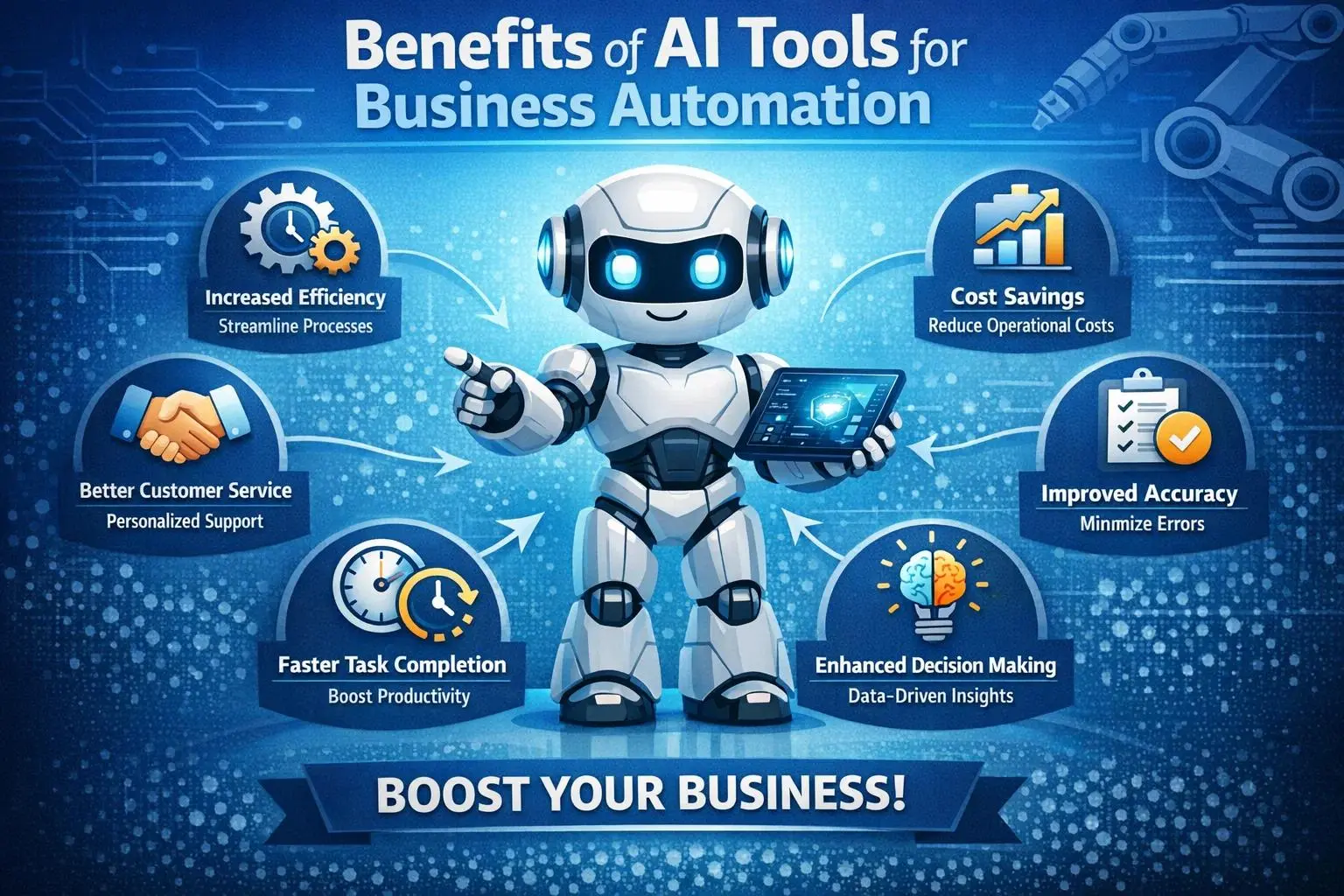
One of the biggest benefits of AI tools is their ability to reduce the time required to complete routine tasks.
Professionals often spend hours writing emails, organizing information, preparing reports, creating presentations, summarizing documents, and managing repetitive activities. AI tools can assist with many of these tasks in a fraction of the time.
For example, a business owner can use an AI assistant to prepare a first draft of a proposal, summarize customer feedback, or create a checklist for an upcoming project.
Similarly, marketing teams can use AI to brainstorm campaign ideas, generate content outlines, and organize their publishing calendars.
AI does not eliminate the need for human involvement. Instead, it provides a faster starting point and allows people to spend more time reviewing, improving, and applying their expertise.
Business benefit: Faster workflows, less repetitive work, and more time for activities that contribute directly to business goals.
Repetitive tasks can consume valuable working hours and increase operational complexity. AI-powered automation can help businesses streamline activities that follow predictable patterns.
Examples include:
When AI is combined with workflow automation, businesses can connect multiple steps into a more efficient process.
For example, an online store might use automation to categorize support messages, identify order-related questions, and direct requests to the correct department.
Businesses should define clear rules for sensitive or high-impact actions and ensure that important decisions receive appropriate human review.
Business benefit: More consistent processes, reduced manual effort, and improved operational efficiency.
Content plays an important role in building brand awareness, attracting website visitors, and communicating with customers. However, consistently creating high-quality content requires planning, research, creativity, and time.
AI tools can support the content creation process by helping marketers develop ideas, organize information, prepare outlines, and refine their writing.
Common applications include:
AI can also help businesses generate multiple versions of a marketing message for different audiences or platforms.
For example, a single product announcement can become a website description, an Instagram caption, an email campaign, and a short promotional script.
However, publishing AI-generated content without checking it can lead to inaccuracies, repetitive writing, or messaging that does not reflect the brand’s personality.
Businesses should add original insights, verify claims, and edit content to ensure it is accurate, useful, and relevant to their audience.
Business benefit: More efficient content production, consistent communication, and stronger support for digital marketing campaigns.
AI is changing the way designers and marketing teams explore visual ideas. AI-powered creative tools can assist with generating concepts, editing images, removing backgrounds, preparing layouts, and experimenting with different design directions.
These capabilities can be useful for:
For example, a business can develop several visual concepts for a product launch before choosing the most suitable direction for its brand.
AI can help speed up early-stage exploration, but professional design still requires an understanding of typography, color, layout, accessibility, brand identity, and audience expectations.
Designers should also review licensing terms and ensure that generated visuals do not misuse protected logos, copyrighted material, or other people’s likenesses.
Business benefit: Faster creative exploration, more design possibilities, and improved collaboration between marketing and design teams.
Businesses generate information through sales, website traffic, customer feedback, marketing campaigns, inventory systems, and other operational activities.
AI tools can help analyze large datasets, summarize trends, identify unusual patterns, and generate questions that guide further investigation.
For example, an e-commerce business might analyze its sales data to understand which products perform well during certain periods. A marketing team might compare campaign results to identify which channels deserve additional attention.
AI-assisted analysis can help businesses:
However, AI-generated insights are only as reliable as the data, assumptions, and methods behind them. Incorrect or incomplete data can lead to misleading conclusions.
Important business decisions should be supported by validated information, appropriate expertise, and clear performance measures.
Business benefit: Faster analysis, better visibility into business operations, and more informed decision-making.
Customers expect businesses to provide timely information, convenient support, and clear answers to their questions.
AI-powered chatbots and virtual assistants can help businesses respond to common questions, guide website visitors, and make information easier to access.
Potential applications include:
For example, a service-based business could add an AI assistant to its website to answer basic questions about available services and help visitors find the appropriate contact channel.
AI customer service should be designed with clear limitations. Customers should be able to reach a human when an issue is complex, sensitive, or unresolved.
Businesses must also protect personal information and avoid allowing AI systems to make unsupported promises about prices, delivery times, or service commitments.
Business benefit: More accessible support, faster responses to routine questions, and a smoother customer journey.
AI can help businesses use their time and resources more effectively. By automating selected tasks and improving existing workflows, organizations may reduce certain administrative expenses and avoid unnecessary duplication of work.
For example, AI-assisted document processing can reduce manual data entry, while automated reporting can reduce the time spent compiling information from multiple sources.
AI may also help teams identify process bottlenecks and determine where additional resources are needed.
However, adopting AI is not automatically cheaper than traditional methods. Businesses may need to pay for subscriptions, integrations, staff training, data preparation, security, and ongoing maintenance.
The best approach is to evaluate AI based on measurable outcomes rather than assuming it will reduce every expense.
Business benefit: Potential savings, more efficient resource allocation, and improved use of existing teams and systems.
Customers respond differently to products, services, and marketing messages. AI can help businesses understand customer preferences and tailor experiences using appropriate, lawfully obtained information.
Examples include:
An online store, for example, may use a recommendation system to display products related to a customer’s current selection.
Personalization should be transparent, proportionate, and respectful of privacy. Businesses should collect only the information they need, follow applicable data-protection requirements, and avoid making intrusive assumptions about customers.
Business benefit: More relevant communication, improved customer engagement, and opportunities to strengthen customer relationships.
AI tools are increasingly useful throughout the software development lifecycle. Developers can use AI assistants to explore code examples, explain unfamiliar functions, create test ideas, identify potential bugs, and document existing systems.
For website and application projects, AI may help teams:
AI-generated code must be reviewed and tested before it is used in a production environment. Security vulnerabilities, outdated approaches, and incorrect assumptions can appear in generated suggestions.
Human developers remain essential for system architecture, security, accessibility, performance, integration, and long-term maintenance.
For businesses planning a new website, e-commerce platform, or mobile application, AI can be a useful supporting technology when combined with sound engineering practices.
Business benefit: Faster experimentation, better developer support, and new opportunities to improve digital products.
Search engine optimization helps businesses make their websites more discoverable to people searching for relevant products, services, and information.
AI tools can support SEO activities by helping marketers research topics, organize keyword themes, identify content gaps, summarize competitor content, and improve article structure.
They may also assist with:
However, AI-generated content alone does not guarantee higher rankings. Search visibility depends on multiple factors, including content usefulness, relevance, website quality, competition, and technical performance.
Businesses should focus on creating original, accurate, people-first content that genuinely answers the reader’s question. AI should support research and writing rather than replace editorial judgment or real expertise.
Business benefit: More efficient SEO workflows and better-organized content strategies.
AI tools can act as learning assistants by explaining difficult topics, generating practice questions, summarizing study materials, and adapting explanations to different skill levels.
Students may use AI to understand concepts, practice languages, and organize revision plans. Professionals may use it to explore new software, learn technical terminology, or prepare for presentations.
For example, someone learning web development can ask an AI assistant to explain a programming concept and provide a simple example.
The most effective use of AI is active learning rather than copying answers without understanding them. Learners should verify important facts, practice independently, and follow their institution’s or employer’s rules.
Business benefit: More accessible learning resources, faster exploration of unfamiliar topics, and support for continuous professional development.
AI makes it easier for teams to explore ideas, test concepts, and investigate potential improvements before investing significant resources.
A startup might use AI to organize customer interview notes. A retailer might explore new ways to improve product discovery. A software team might create an early prototype to evaluate a proposed feature.
AI can also help organizations identify opportunities to improve existing services or develop new digital products.
However, successful innovation depends on more than technology. Businesses still need customer research, practical testing, responsible implementation, and a clear understanding of the problem they are trying to solve.
Business benefit: Faster experimentation, improved idea development, and opportunities to differentiate products and services.

The right AI tool depends on the task, budget, data requirements, and expected results. The following examples illustrate different categories of AI-assisted work.
Useful for brainstorming, drafting, summarizing, explaining concepts, and assisting with research and problem-solving.
Useful for AI-assisted writing, information exploration, brainstorming, and tasks supported by its available integrations and features.
Useful for supported productivity tasks, drafting, summarization, and assistance within compatible Microsoft products.
Useful for exploring visual concepts, creating design drafts, and assisting with marketing graphics and presentations.
Useful for checking writing, improving clarity, and refining tone and grammar.
Useful for code suggestions, programming assistance, and supporting selected software development tasks.
Useful for exploring data, identifying patterns, creating summaries, and supporting reporting workflows, depending on the product and data source.
Features, pricing, integrations, and availability can change. Businesses should review each provider’s current terms, privacy practices, and capabilities before choosing a tool.
Selecting AI tools should begin with business needs rather than trends.
Step 1: Identify the problem. Determine which activity takes too much time, creates recurring errors, or limits your team’s ability to deliver results.
Step 2: Define the desired outcome. Establish a measurable goal, such as reducing time spent on routine reporting or improving response times for common support questions.
Step 3: Compare available tools. Review features, pricing, ease of use, integrations, security, data handling, and support.
Step 4: Start with a small pilot. Test the tool on a limited workflow before introducing it across the organization.
Step 5: Train your team. Explain how to use the tool, check its outputs, protect sensitive information, and escalate issues.
Step 6: Measure the results. Compare time, quality, error rates, customer feedback, and total cost before and after implementation.
Step 7: Improve continuously. Review performance regularly and update the process as business requirements change.
This practical approach helps businesses focus on useful outcomes instead of adopting tools that do not solve a real problem.
Although AI offers significant opportunities, responsible adoption requires an understanding of its limitations.
AI can produce incorrect facts, misleading summaries, or fabricated references. Verify important claims against trustworthy sources.
Do not enter confidential business information, customer records, passwords, or sensitive personal data into a tool unless its use is approved and appropriate safeguards are in place.
AI systems may reflect biases in their training data or design. Review outputs for unfair assumptions, especially in high-impact applications.
AI should not automatically replace professional judgment in sensitive decisions involving health, legal matters, finance, employment, or safety.
Subscriptions, implementation, staff training, and maintenance can add up. Evaluate total cost and compatibility with existing systems.
Check the applicable terms and permissions for AI-generated text, code, images, and other creative work. Review outputs before commercial use.
Teams still need the skills to question AI results, solve problems independently, and understand the systems they operate.
The goal should be to combine AI’s capabilities with human expertise, accountability, and responsible decision-making.
AI technology continues to develop, creating new possibilities for software, digital marketing, customer service, design, analytics, and business automation.
In the coming years, organizations may increasingly combine AI assistants with existing applications and carefully designed workflows. These systems could help coordinate routine tasks, summarize information across approved data sources, and support more personalized digital experiences.
At the same time, privacy, cybersecurity, transparency, and accountability will remain essential.
Businesses that build a strong digital foundation, train their teams, and evaluate AI through practical use cases will be better positioned to adapt as the technology evolves.
AI should not be viewed as a replacement for every human activity. Its greatest value often comes from helping people spend less time on repetitive work and more time on creativity, relationships, strategy, and innovation.
At OSFILLING, we focus on digital solutions that help businesses establish and improve their online presence. Our digital services include website development, e-commerce development, software development, Android and iOS application development, graphic design, SEO, and website maintenance.
As businesses explore AI and automation, the right digital foundation becomes increasingly important.
Depending on your requirements, a digital project may involve:
AI features or automation can be considered where they provide a clear benefit and are appropriate for the project. The right solution depends on your business objectives, technical requirements, budget, and data-protection needs.
Explore our services: https://osfilling.com
AI tools are changing how individuals and businesses approach productivity, creativity, data analysis, customer service, marketing, and software development.
They can help save time, automate selected tasks, generate ideas, improve workflows, and make information easier to analyze. At the same time, they require careful evaluation, human oversight, and responsible data practices.
The best results come from choosing tools that solve real problems, checking their outputs, measuring their performance, and combining automation with human expertise.
Whether you are running a startup, managing an established company, or developing a new digital product, now is a valuable time to explore where AI can make your work more effective.
Ready to strengthen your digital presence?
Connect with OSFILLING to explore website development, software solutions, mobile applications, SEO, graphic design, and other digital services for your business.
Visit: https://osfilling.com
